
Hawaii Recent Arrests
Hawaii does not publish one state arrest roster. Each county police department keeps its own arrest records. The Hawaiʻi Police Department covers its island, the Honolulu Police Department its own, and Kauaʻi and Maui the same way. What they release varies. Dated PDFs, rolling reports, and selected news posts never add up to a full list of everyone arrested. Kalawao County has no separate police publication in the statewide source map, so a neighboring county or a state unit may have made the arrest. One more habit helps. Keep the arrest event, current custody, and the court outcome in three separate mental boxes when you check a Hawaii record.
Note: A booking photograph documents the arrest event itself, while later court records show what followed from it.
Hawaii Arrest Record Fields
No single statewide booking form exists. Honolulu's public-access policy spells out the fields in its adult arrest log. Kauaʻi publishes charge rows with release codes. DCR's SAVIN layer reports covered custody events. The table splits known fields like these from name-based or case-number searches. A blank field never proves an agency skipped the record.
| Field or search input | What the Hawaii source shows |
|---|---|
| Name and age | Named in Honolulu adult arrest-log policy; verify identity beyond a name match. |
| Arrest date and time | Recorded in Honolulu’s public log; county PDFs may cover different reporting windows. |
| Sex, race, arresting officer | Fields identified by Honolulu’s public-access policy, not a promise about every county report. |
| Nature of offense and report number | Honolulu log fields that point to the arrest event, not the full case narrative. |
| Release time and manner | HPD may add these later. A blank value does not prove a person remains in custody. |
| Charge rows and status code | Kauaʻi reports one row per charge and a processing code; a row count is not a people count. |
| Person name, offender number, case number | VINELink search inputs documented for covered records; an identifier is useful when available. |
| Custody, facility, transfer, release | SAVIN/VINELink may show these state-system events. No official public photo field was confirmed. |
| Booking photo | May be held by the arresting police agency; the public arrest PDFs reviewed do not display a photo gallery. |
The record you get depends on agency and stage. A county police log captures the arrest event. A court file picks up the charge later. A DCR result shows covered custody after entry into the state system. None of these three updates on the same clock or repeats the same fields.
Request a Hawaii Arrest Record
For a county arrest report or booking photo, ask the police department. Ask the one that made it or holds it. State requests work the same way. Send them to the agency that keeps the specific record. For a DCR case file, that means DCR. UIPA cannot force an agency to build a new statewide arrest spreadsheet it never kept. Make the request easy to fill. Name the record, the date range, the location, and your preferred format.
- Identify the arresting agency from the county report, release, or known location. The four county police departments have separate record systems.
- Open that agency’s official records or UIPA request route. For DCR material, use DCR’s records contact; do not assume DCR has the county police photograph.
- Describe the person and event as precisely as known, including the date, location, report number, record type, and whether the request seeks a copy or inspection.
- Ask for the existing booking record, releasable photograph, or custody record. The custodian may redact or withhold protected parts under a law or court order.
- Track the response and ask what retention schedule applies if the record is no longer held. A web page’s short display window is not the same as agency retention.
The Office of Information Practices sets UIPA rules for formal requests: a general response or notice period of 10 business days, with extensions allowed depending on the record type. Fees are tiered. Search time runs $2.50 per 15 minutes, and review or segregation time costs $5 per 15 minutes. The first $30 is waived. Copying, postage, or other lawful charges may still apply. Ask the custodian for an estimate before work begins.
Can a statewide office send every county booking photo? No. No single state office keeps a compiled public roster of all county arrests. The request belongs with the agency that created the record or holds it now.
Note: A request for a copy and a live custody question go to different record holders, even when they concern the same arrest.
Hawaii Mugshot Law
Hawaii has no statute that generally bans release or publication of an adult booking photo. Nor is there a statewide anti-pay-to-remove rule. UIPA starts from openness instead. Government records are public. An exception or another law can restrict them. The Office of Information Practices has reviewed county police booking photos. It has treated them as public records in those circumstances. That treatment still does not force routine publication. Privacy, juvenile, investigation, and court-order limits stay in place.
An older OIP opinion draws one bright line. An arrest can be expunged. After that, the official mugshot tied to it is protected from public inspection and copying. Juvenile police and Family Court records follow their own confidentiality rules. In 2024, SB2631 proposed commercial mugshot restrictions, including a pay-to-remove ban. It did not become law. Treat the proposal as history, not as a current Hawaii statute. UIPA, chapter 846, juvenile-record rules, and expungement law still govern access to any specific record.
Need a correction after an eligible expungement? Start with the official Hawaii Criminal Justice Data Center expungement process. A court order can change the official record's access status. Copies held by publishers, search engines, or archives are separate records.
Hawaii considered a commercial publication limit and passed on it. The present rule comes from UIPA, chapter 846, agency policy, and expungement law. That distinction matters for anyone reading an arrest photo fairly.
Hawaii law: An adult booking photo held by police may be a public record under UIPA. No general statute bans publication or creates a statewide pay-to-remove rule. Juvenile, sealed, expunged, and otherwise protected records stay restricted.
Four County Feed Patterns
Each of Hawaii’s four counties reports bookings its own way. Honolulu breaks its log into dated segments. Hawaii County runs a rolling report that spans roughly 48 hours. Kauaʻi posts a dated daily PDF, usually the next morning. Maui’s news archive covers selected events only. The department publishes no full public booking roster. There is no shared statewide feed behind these pages.
| Agency | Public view | Photo and timing limit |
|---|---|---|
| Honolulu Police Department | Several dated PDF segments through the arrest-log page. | Text rows, no public photo gallery; daily uploads, not minute-by-minute. |
| Hawaiʻi Police Department | Rolling booking log for an approximately 48-hour period. | Reviewed PDF is text-only; arrest and charge times can differ. |
| Kauaʻi Police Department | Dated daily PDF report, commonly posted the next morning. | Reviewed report has no photos and may have date gaps. |
| Maui Police Department | Selected news posts; no complete public same-day roster located. | Story photos are selective and do not form a booking feed. |
The Hawaiʻi Police Department booking-log page shows the rolling format in practice. The page explains that one person can show up twice. That happens when the arrest time and the charge time differ, so repeat rows are not always separate arrests.
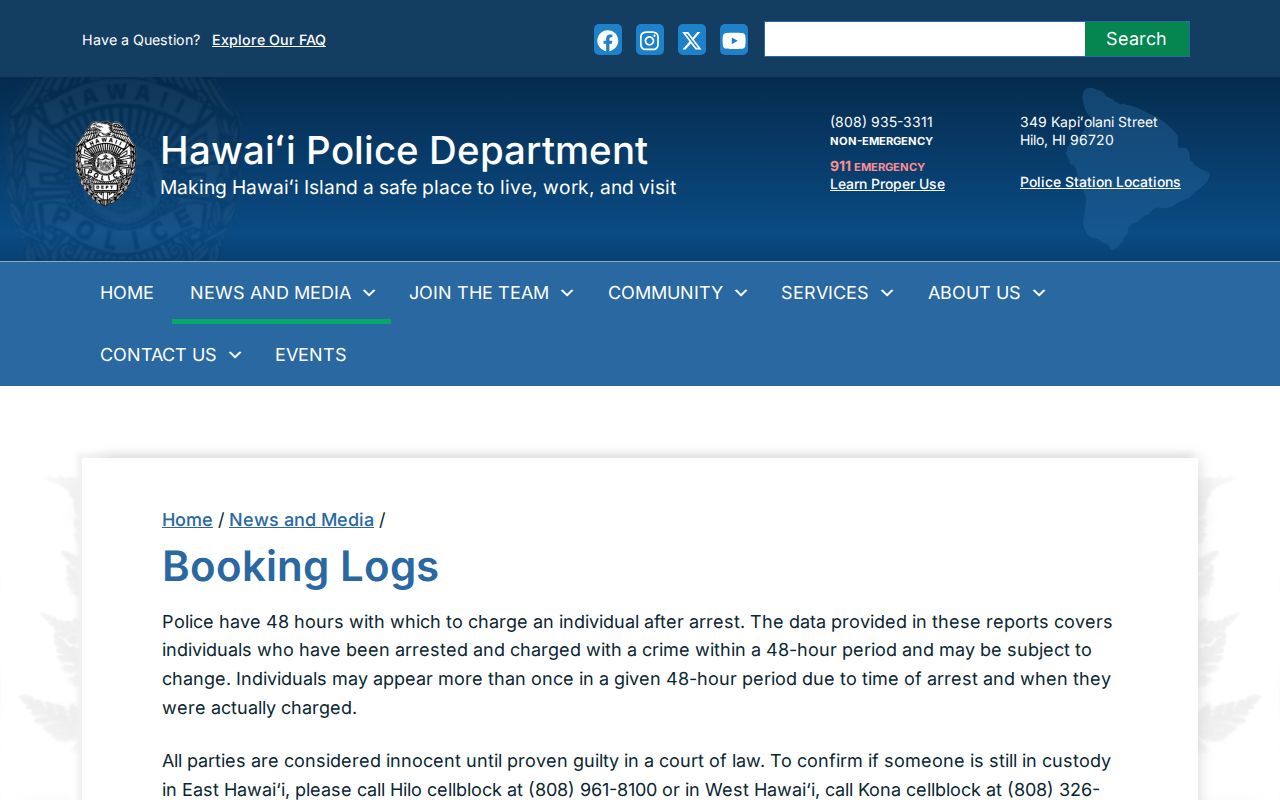
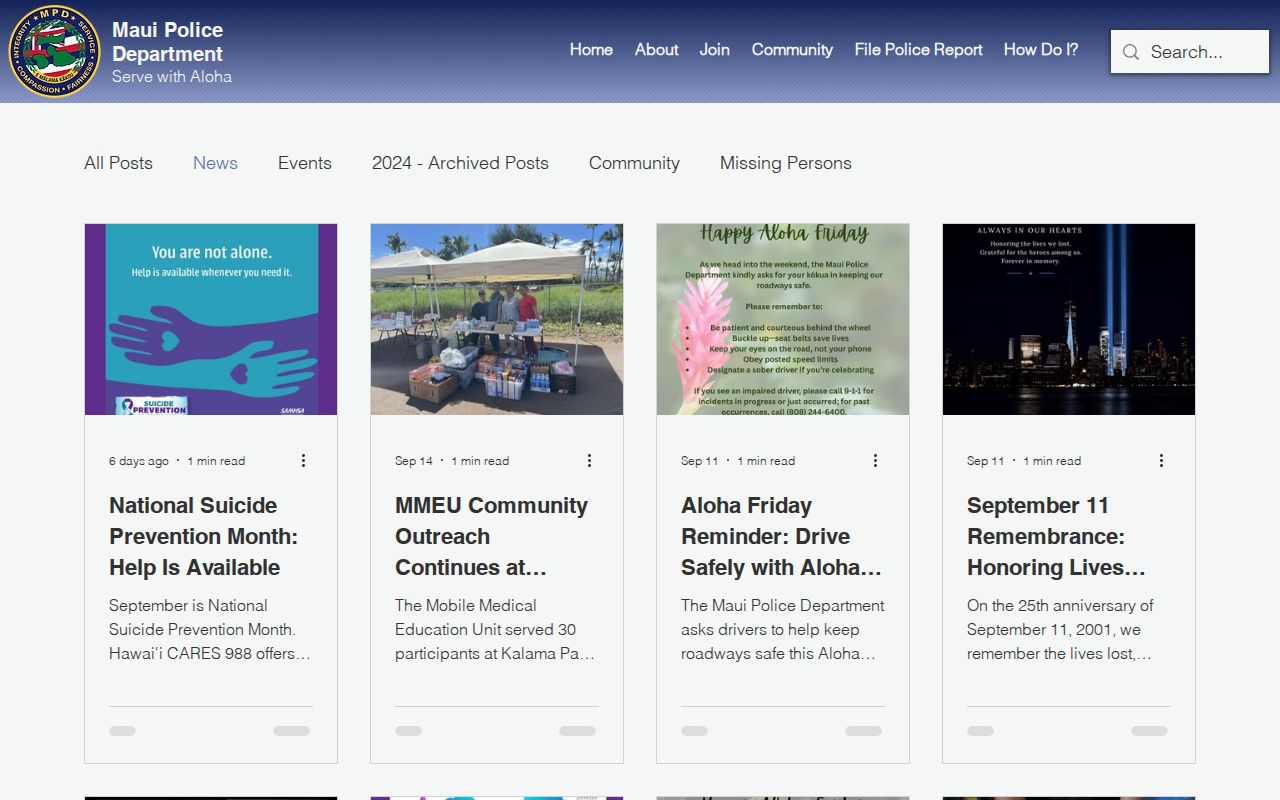
This is a text report, not a photo gallery or live custody check. Check the report date first. Then call the arresting agency about anything fresh or missing. For Maui, the Maui Police Department news archive is the closest official view. Its posts cover selected communications rather than every booking.
Arrested Today compares same-day reports across counties, while Arrest Reports collects the longer logs and archives. Both keep each county’s own limits. An empty page proves nothing. The county, the report date, and the record custodian matter far more than any statewide keyword search.
Find Recent Arrests in Hawaii
A good Hawaii arrest search starts with the event itself. Then find the system that answers your next question. No single county roster covers the state. When you know where the arrest happened, begin with that county’s own source, then confirm custody or court status with the office that holds that record.
- Choose the county or island tied to the event; do not assume Honolulu is the only statewide source.
- Open the latest official arrest report or log for that county and note its reporting dates.
- If the report is absent or has aged off the page, contact the arresting agency’s records office under UIPA.
- For custody after state intake, search Hawaiʻi SAVIN through VINELink; a fresh police-cellblock booking may not appear yet.
- For a filed case or later disposition, check eCourt Kōkua and then contact the court clerk if the public view is incomplete.
Need a photograph? Ask the arresting agency whether it holds a booking image it can release. A news photo, a DCR custody record, and an unofficial repost are three different things.
Note: Keep the official report date with the record so a later search can distinguish a new entry from an older repost.
Where Hawaii Mugshots Appear
Start with official sources. The county police logs behind the statewide map are mostly text reports. None of the four counties publishes a complete public photo gallery. Some agencies do release selected images in a wanted appeal or a media post. An adult police-held photo can be requested under UIPA. The custodian decides whether an exception or a later expungement applies.
| Source | What it may show | Status and caution |
|---|---|---|
| County police reports | Arrest event, charge, and date; selected releases may include a photo. | Official, but not one combined roster; reviewed PDFs had no photo gallery. |
| Police records office | Existing arrest report or releasable booking image by request. | Official custodian; juvenile, sealed, expunged, and protected records are restricted. |
| DCR / SAVIN | Covered custody, transfer, or release status. | Official state layer; no public offender photo field was confirmed. |
| Local news reports | Selected arrests, wanted notices, investigations, or court developments. | Editorial selection, not a complete feed; captions and later updates matter. |
| RecentlyBooked Hawaii | Honolulu coverage appeared during the research review. | Partial, unofficial, and potentially stale; no all-county coverage was verified. |
| Mugshots.com | Historical state index and directory material. | Unofficial, not a dependable current county roster. |
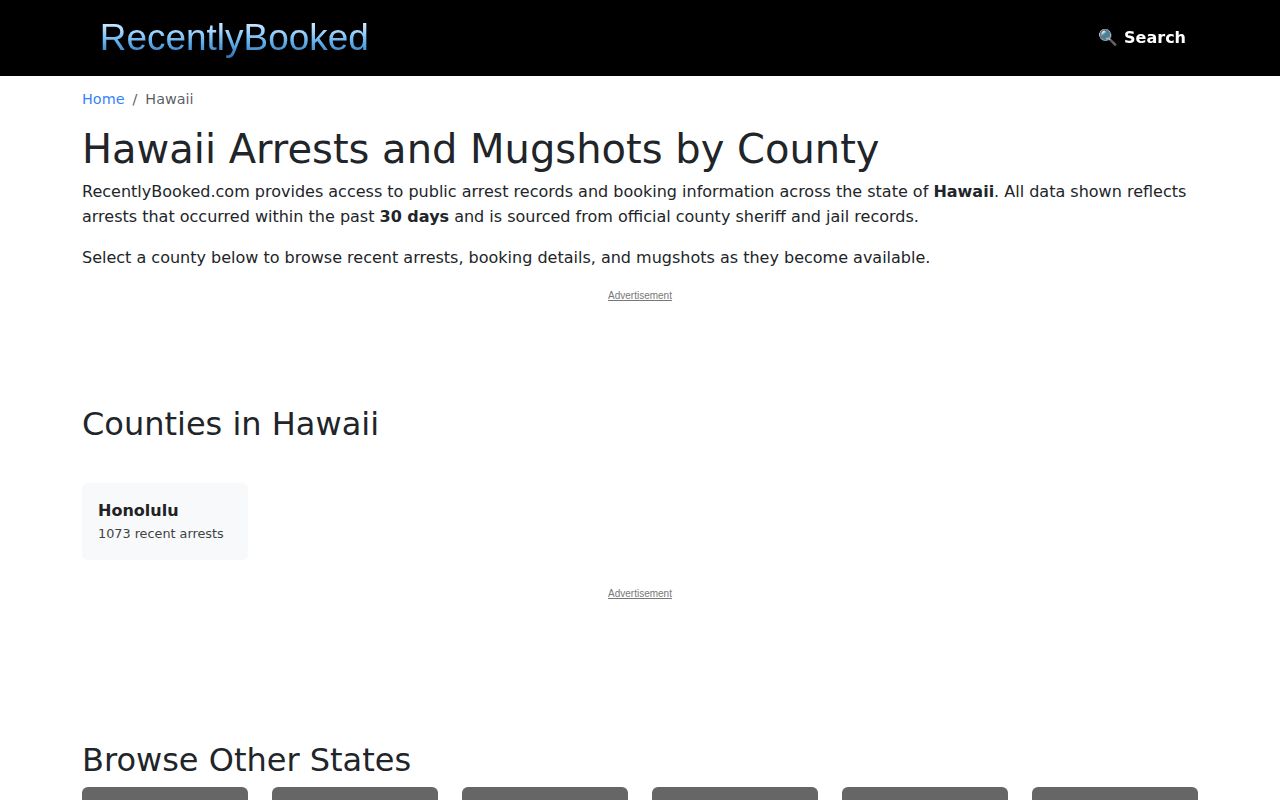
RecentlyBooked’s Hawaii landing page offers only partial county navigation. Its listings are secondary material, so weigh them against the police agency and the court record.
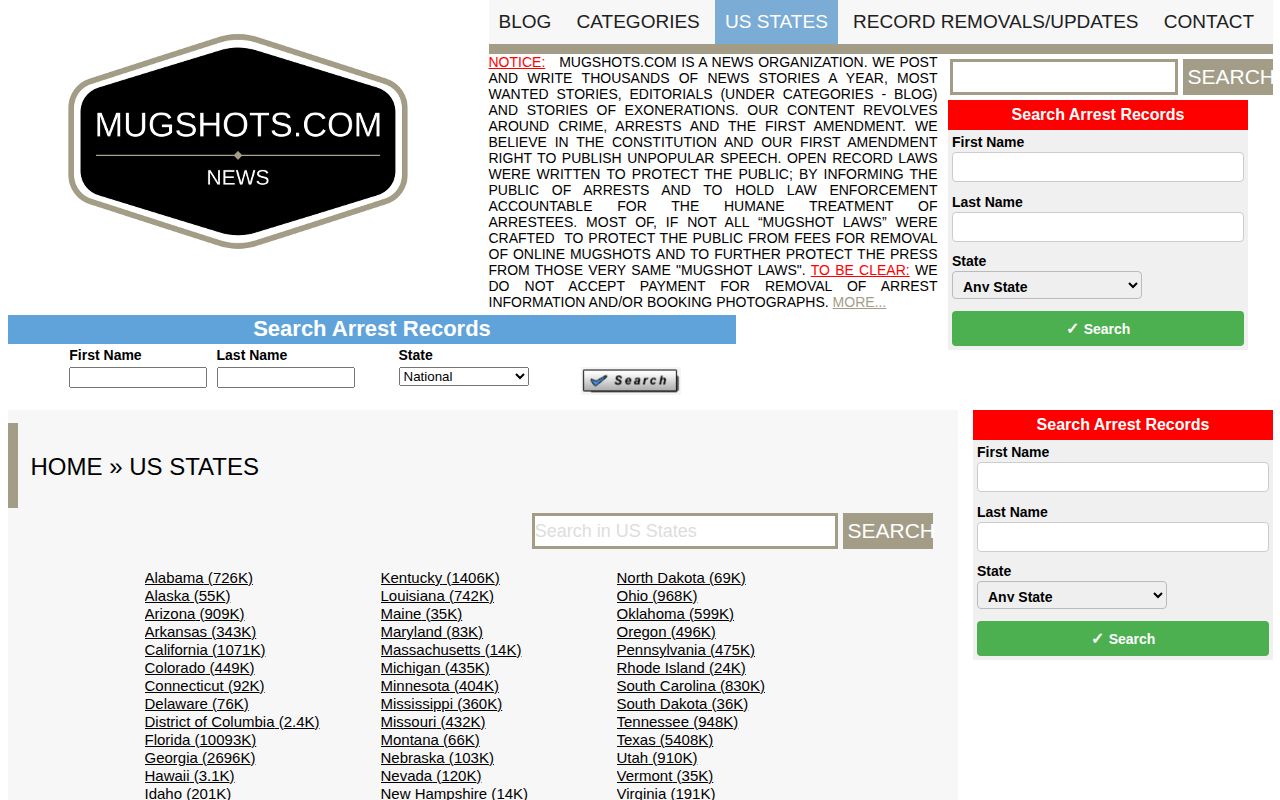
Mugshots.com’s state index is another secondary route. It can surface old or incomplete material. Both RecentlyBooked and Mugshots.com describe a free, documentation-based correction path for certain listings. But those private policies change only their own pages, never an official Hawaii record. Busted Newspaper, Arrests.org, and Mugshots.zone list no current Hawaii state or county section. A stale third-party entry is not a government finding either way.
An outside publisher’s photograph can linger online long after the official record changes. It may never reflect a later correction or a court outcome.
Hawaii Same-Day Arrests
“Same day” means something different in each county. Honolulu’s newest dated segments form a practical recent window. Hawaii County’s rolling report reaches back about 48 hours. Kauaʻi’s report usually lands the following morning. Maui lists no public same-day booking URL. A fresh arrest may sit in processing or wait for the next upload, so the report can describe an event after custody has changed. The Honolulu Police Department arrest-log page presents dated segments rather than a live search box. It is a solid event view. Still, a name missing from the newest file does not rule out a pending entry, a release, or an arrest by another agency.
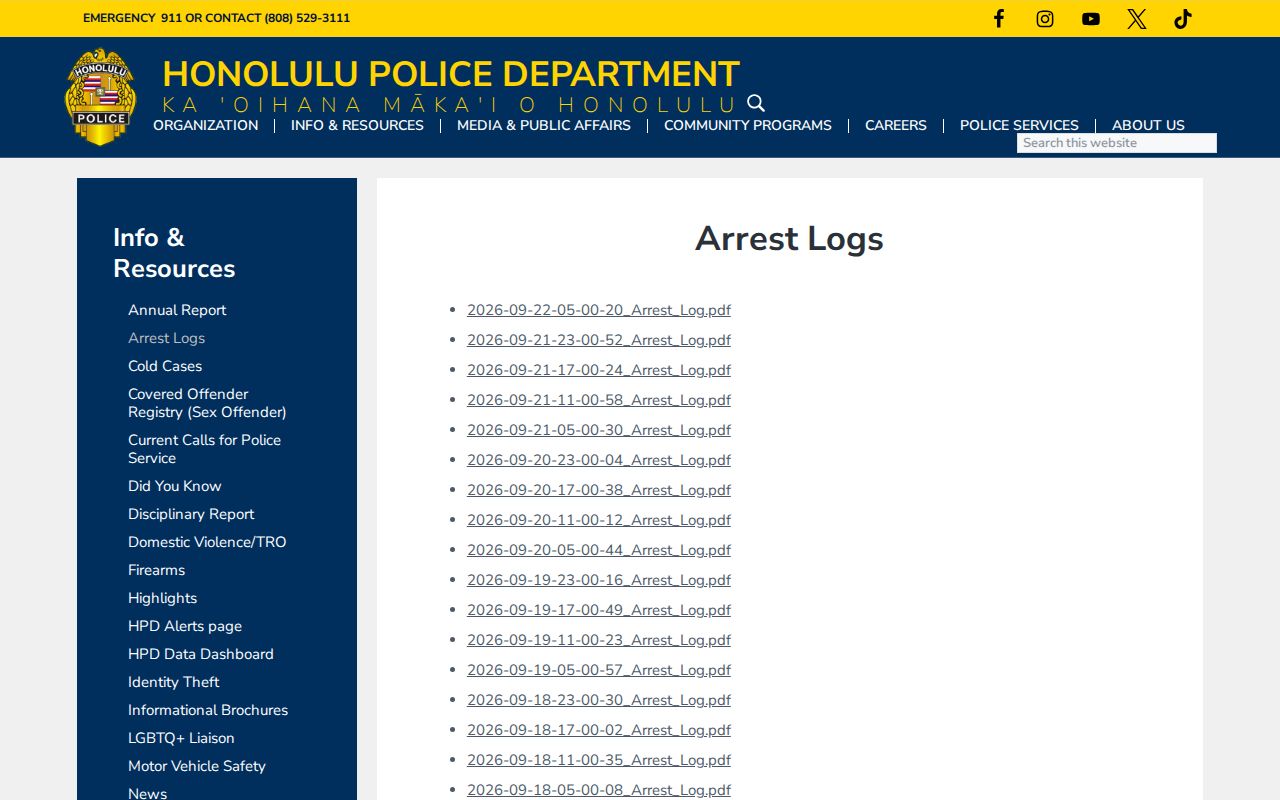
Every agency sets its own report period. No single Hawaii feed captures each arrest as it happens. A same-day view should honor the report’s actual window. Do not force every source into a 24-hour frame. Verify timing: reports can lag booking, and an arrest log is not a live custody feed, so call the arresting agency for current status.
Note: Report timestamps describe publication or event timing; neither one guarantees that a person remains in custody when the file is opened.
Hawaii Warrants and Wanted Lists
Hawaii publishes no single statewide most-wanted roster. The work is spread across agencies instead. County police issue dated wanted notices. The Department of Law Enforcement's Sheriff Division handles statewide warrants and serves process. The U.S. Marshals Service District of Hawaii profiles selected federal fugitives. None of these channels lists every active warrant in one place.
The U.S. Marshals Service District of Hawaii page describes its fugitive task force. It posts selected profiles. It also lists a 24-hour tip line at 1-888-869-4589. The Sheriff Division serves warrants and transports detainees, but it offers no public all-warrants search. The Judiciary's eBench warrant portal stays restricted to justice users. The public eCourt case search cannot confirm an active warrant.
Worried about a warrant in your own name? Confirm it with the law-enforcement agency, the court clerk, or an attorney. A caller demanding money over supposed missed jury duty or an arrest warrant is running a scam. It is not verifying anything. If a wanted notice says the person may be dangerous, do not approach. Call 911 or the listed contact instead.
A missing name in a wanted post does not mean no warrant exists. Likewise, a DCR/VINELink result is not an absconder list. It reports covered custody and notification events. Safety first: never try to locate, follow, or confront a wanted person. Send tips to law enforcement and let trained officers make contact.
Hawaii SAVIN Arrest Alerts
Hawaii SAVIN is the state's VINE service, run by DCR and delivered through VINELink. A one-time lookup shows covered custody information. You can also register for free alerts about release, transfer, discharge, escape, or parole events. Registration works when the record and interface allow. The service tracks custody after someone enters the covered state system. It does not track every new county arrest.
For a fresh arrest, start with the arresting county's report or records office. Police guidance notes the cellblock stage can come before the court system and SAVIN coverage. Once a covered state record exists, Hawaii SAVIN offers a separate one-person search. Alert registration is available there too.
Note: A no-result means no matching covered record was found at that moment; it does not prove there was no arrest.
Hawaii Arrest Portals
Different questions point to different portals. County police hold the initial arrest reports. eCourt Kōkua offers public case information and selected documents. HCJDC's eCrim service is conviction-oriented. DCR/VINELink tracks covered custody. No single portal combines all four layers into a full arrest history. A no-result from one source says nothing about the rest.
The Hawaiʻi Judiciary's eCourt Kōkua access page describes public case search, paid documents, and restricted records. A recent arrest may not have a filed case yet. It may carry a different charge. It may also be sealed or juvenile. Case information is neither a booking roster nor a certified court record.
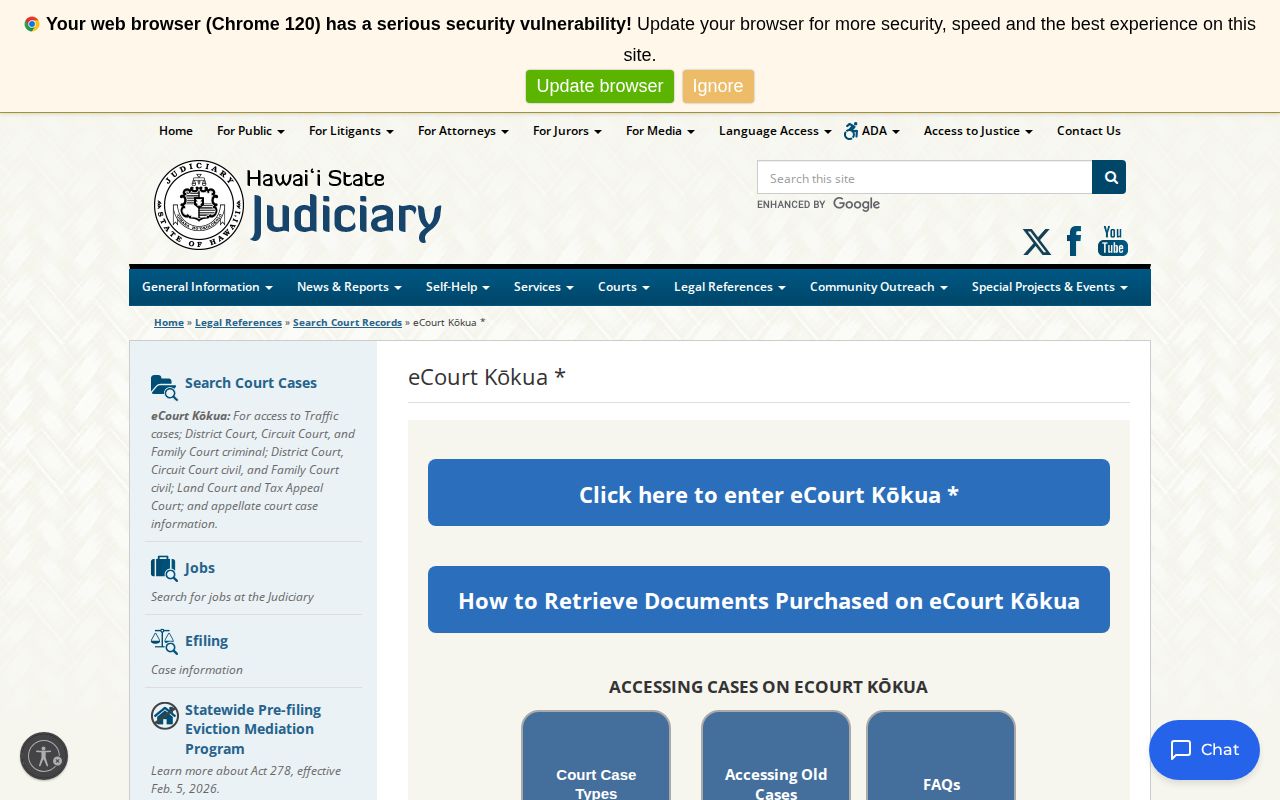
Checking a later court outcome? Compare the docket with the original arrest record and note when each was checked. Confidential, sealed, and juvenile material stays out of ordinary public case displays.
DCR Custody Status
The Hawaiʻi Department of Corrections and Rehabilitation (DCR) runs the state correctional system, including four community correctional centers and the state prisons. Those centers form the state-jail layer in each county catchment. They are not four county-run sheriff rosters. A DCR facility page is not a person-level booking search, either.
The official DCR Corrections Division page describes the agency and its facilities. A person can move from a county police cellblock to court, a DCR intake service center, a community correctional center, a prison, release, or federal custody. Each handoff can shift which agency holds the current record.
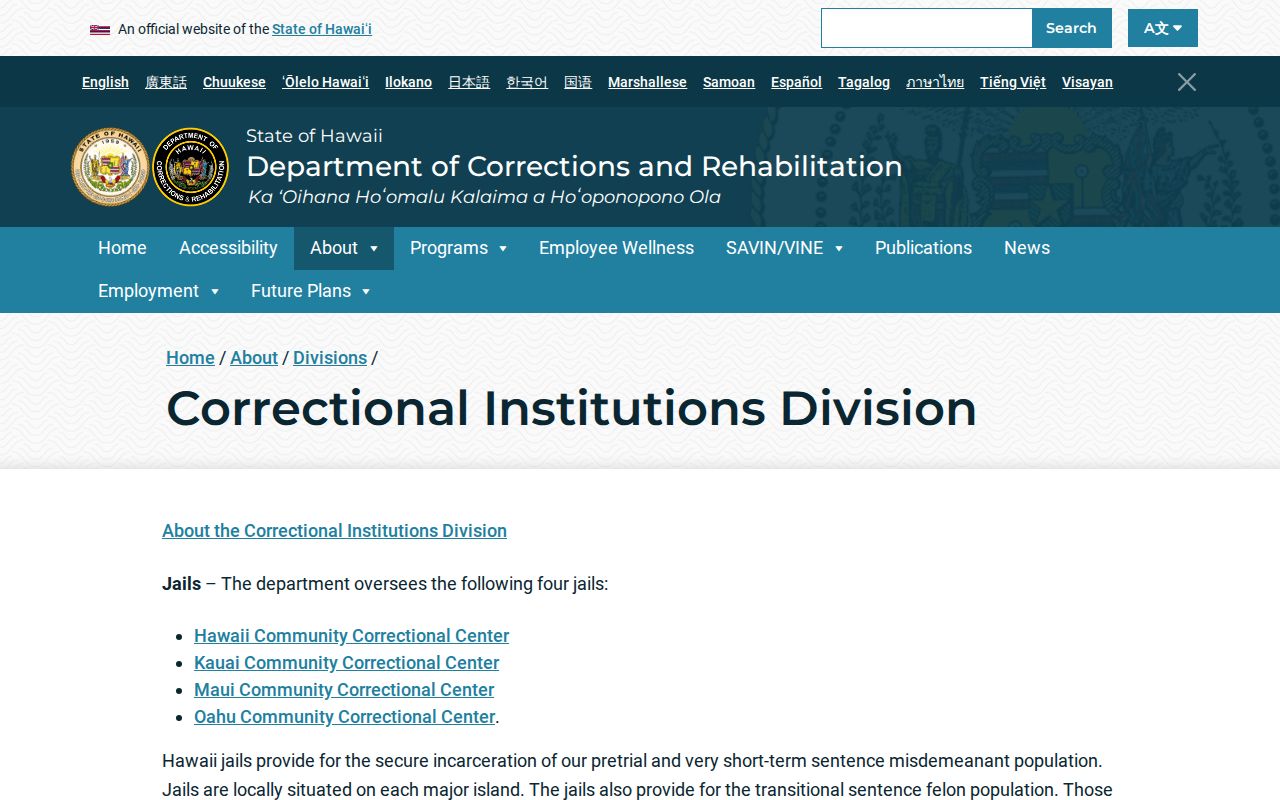
DCR/VINELink publishes no public photo field. Want an arrest photograph? Ask the police agency that made the arrest. For a state custody question, use SAVIN once the person reaches its covered system.
Federal Arrest Custody Records
A federal arrest follows a separate custody path. The Federal Bureau of Prisons Inmate Locator searches people in BOP custody. It is not a county booking log. It offers no public gallery of booking photos. Immigration detention sits in yet another system. The ICE Online Detainee Locator can find someone in ICE custody when its identifier and data conditions are met. Neither system covers every recently arrested person.
Someone can be held briefly by county police. They may then be released, moved to state custody, or transferred to a federal agency. A federal locator may miss a newly arrested person or someone outside its searchable records. Verify with the agency holding the person now. A no-result in BOP, ICE, DCR, or a county report settles nothing. It says nothing about the other systems.
Expungement Rules in Hawaii
HRS §831-3.2 provides a process for eligible arrest records to be annulled and placed in a confidential file. The statute defines the arrest record to include related photo and fingerprint cards, and an eligible applicant may request those materials back. The law has exclusions and waiting periods, so dismissal alone does not mean a record has already been expunged.
Two recent changes affect the later record trail. Since July 1, 2025, HCJDC says qualifying orders with a court case number are automatically sent to the Judiciary for consideration of sealing or removal from public electronic records. Act 152 (2026) clarified eligibility when a charge for a crime results in a violation conviction. These changes do not promise that every independent publisher or cached copy disappears.
HCJDC states that an application takes 120 days and lists current fees and required payment types on its official page. A person should use that live guidance and the current application rather than infer eligibility from a charge outcome. Corrections to an official file, a free publisher policy, and a search-engine refresh are separate steps.
Note: An expungement order can change official disclosure while an independent copy remains outside the government record system.
Hawaii Historical Record Archives
Hawaii's archival prisoner papers are a different animal from today's arrest logs. The State Archives finding aid covers Department of Public Safety jail and prison collections spanning 1851 to 1941. Those collections include registers, prisoner descriptions, and one volume of photographs. That path suits historical research. It is not a digitized search for current county booking images.
For digitized material, the State Archives Photograph Collection leads to images and the Digital Archives. Finding aids help you pin down a collection. Make your request after that. Even a public catalog record can carry restrictions. Donor, copyright, or use limits may apply to the image itself.
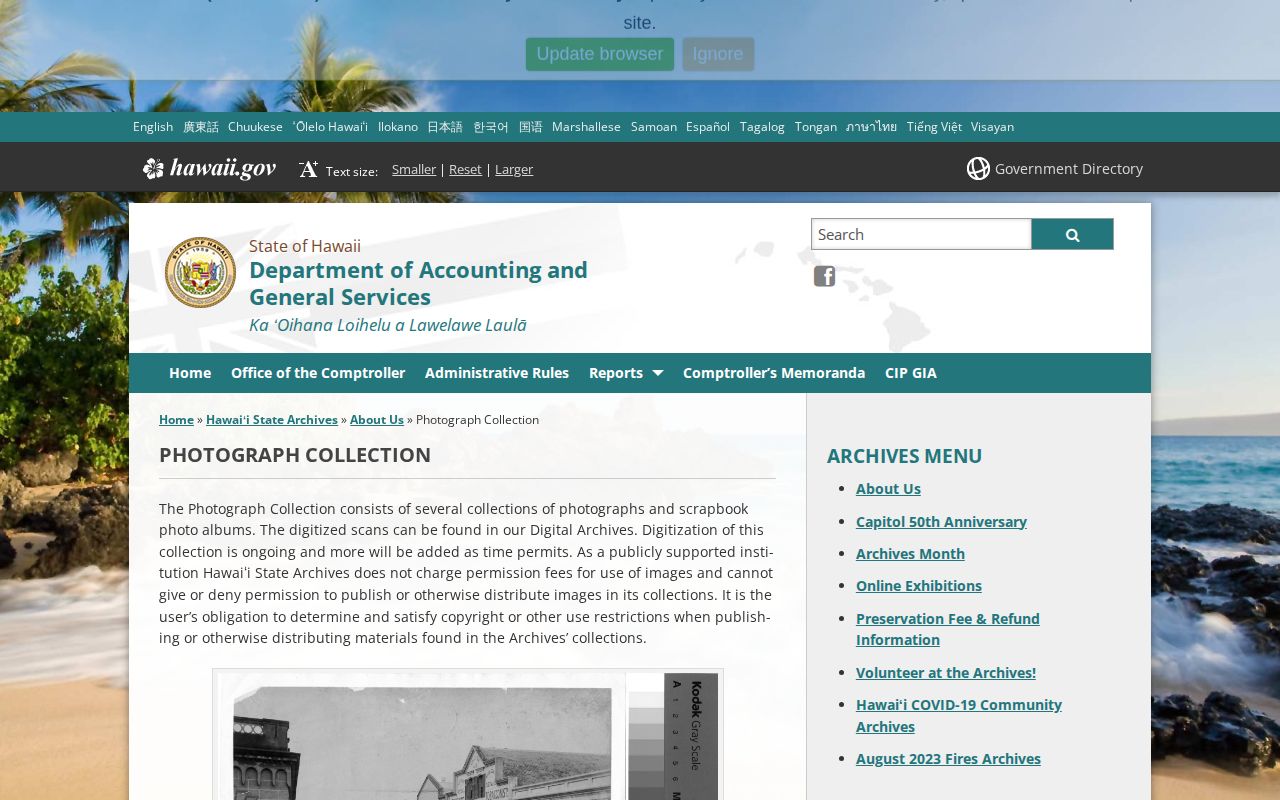
State Archives retention schedules set the minimum time and final disposition for each state record series. A schedule is not a promise that a PDF stays on a police web page. When a modern record is missing, ask the original custodian whether it still exists, was transferred, or was disposed of under a schedule.
Note: Archive retrieval is a staff-assisted research process, not an instant lookup for a current custody status.
Hawaii DLE Arrest News
Hawaii has no State Police, State Patrol, or Highway Patrol. The statewide office in that role is the Department of Law Enforcement, or DLE. Its Sheriff Division does much of the work. The DLE news archive holds selected releases. It is not a daily arrest log or complete roster.
The Sheriff Division serves warrants and handles detainees. It also provides security and transport across state facilities, Judiciary sites, and other statewide functions. It runs no single public booking roster. Custody destination hinges on the arresting authority and court path. The right source may be a county department, DCR, or a federal one rather than one shared jail.
HDOT's Motor Vehicle Safety Office deals with commercial-vehicle safety, not highway-patrol arrest news. To request DLE records, use its UIPA channel. Describe the event and record sought. Its newsroom and request route sit apart from county arrest logs and DCR custody records.
Hawaii Arrest Feed Differences
What counts as recent shifts from county to county. Honolulu's segmented PDFs appear more often than a next-morning daily report. Public logs rotate out after 14 days. Hawaii County's rolling 48-hour files can overlap. Kauaʻi's charge-by-charge report leans on a release legend, and Maui's news page is no complete booking feed. These are limits of the sources, not hints about any one person.
Compare entries by report date and source agency. A county feed can age off while the underlying police record stays requestable. Overlaps can repeat a name or charge, and the public archive can show date gaps. Read the daily report and the shallow rolling window with care. Mind their own dates and labels.
Hawaii Arrest Photo Variation
Photo access depends on the record and the agency. The Honolulu, Hawaii County, and Kauaʻi arrest PDFs are text or table reports with no public photo column. County police may post a selected image in a wanted appeal or a serious-case release. A records unit can still hold an individual photo even when the feed shows none.
Private sites copy public material, yet their entries can leave out a later dismissal, expungement, or correction. RecentlyBooked carries Honolulu coverage, while Mugshots.com's state index is historical rather than a dependable live roster. Other major sites list no current Hawaii section. These publishers describe free correction policies for qualifying records. But those private rules are not Hawaii law and never change the government file. Check official status first.
Statewide newsrooms publish selected arrest and court stories. Hawaii News Now, the Star-Advertiser, Civil Beat, KHON2, KITV, and Hawaii Public Radio all do this. That is coverage, not a complete log.
Hawaii Records Portals Stay Separate
Each portal answers one question only. UIPA requests belong with the agency that holds the record. eCourt Kōkua covers public case information and selected documents. HCJDC, through eCrim, leans toward convictions. DCR and VINELink handle covered custody questions. Court results can lag an arrest, a DCR result starts only after state-system entry, and no single search speaks for every custodian.
Track the purpose and date of each check. When an arrest report shows but no court case does, the case may be unfiled or restricted. A missing custody result has many explanations: a police cellblock, release, federal custody, or a spot outside the covered system. Ask the custodian instead of treating an empty search as final.
Note: The State Archives and records offices can explain retention or transfer, but they do not create a live statewide feed.
Which Jails Feed SAVIN
Hawaii SAVIN covers the whole state. Yet its public documentation offers no county enrollment figures. The structure is clear, though. DCR runs four community correctional centers with intake service centers, one for each county catchment. Arrests can sit in a police cellblock before that state layer ever sees them.
Each county has its own path. Hawaiʻi County sends people toward Hawaiʻi Community Correctional Center and its intake centers. Honolulu's state custody runs through Oʻahu Community Correctional Center. Kauaʻi and Maui each operate their own centers and intake services. Prisons and parole add another DCR layer entirely.
Coverage is not instant notice. The map describes which facilities participate, not a promise that every booking appears right away.
The lookup stays anonymous and alerts cost nothing. Phone, text, email, app, and TTY options are documented. Yet delays still happen. For someone held in a county cellblock, call that agency's booking or records contact first.
Hawaii Court Outcomes After Arrest
An arrest is only the start of the court story. Prosecutors may file charges or amend them. They can also decline charges entirely. From there, a court can record a plea, a dismissal, an acquittal, a conviction, or diversion. Arraignment comes early, where charges and rights get addressed. Bond is simply a release condition set along the way. Disposition is the court's final word on the case.
Never treat a booking charge as the ending. eCourt Kōkua may lag behind the police log. Juvenile or sealed records follow separate access rules. When the public docket looks thin, the court clerk is the right contact. The true outcome lives in the court record, not in a reposted arrest item.
Hawaii Arrest Log Archives
What stays on a website is not the same as what the office keeps. Honolulu's arrest logs rotate off the site and out of Central Receiving after 14 days. Hawaii County posted a shallow run of rolling 48-hour files with no stated retention period. Kauaʻi's daily PDFs reached back about a month, with a date gap and no promise of permanence.
When a report vanishes, ask the police records office. Is it still held, moved to another series, or disposed under a valid schedule? The State Archives holds historical corrections material. Modern county arrest files do not transfer there automatically. A deleted webpage is not a destroyed record.