
Hawaii Arrest Record Access
Start with the headline question. Is an adult booking photo public? Under Hawaii's Uniform Information Practices Act, a county police mugshot can be a government record open to the public. The state Office of Information Practices said exactly that in Opinion 94-12. That ruling covers access, not delivery. An agency must still review each record and apply any legal limits before release. Nothing in UIPA forces every photo onto a website. UIPA begins with openness. HRS §92F-11 presumes government records are open unless a law says otherwise. The exceptions live in HRS §92F-13, which covers privacy, litigation, government functions, conflicting statutes, and court orders. An agency can hand out the public parts and redact the rest. A partial release does not mean the file is sealed. It just means one slice was withheld.
UIPA does not oblige an agency to build a statewide arrest database from county files. County arrest data stays with county custodians. So name the likely holder of the record and request an existing document, with a clear date range and location, rather than asking for a new compilation.
Note: Public access is a record-by-record rule, not a promise that every arrest or photo will appear online.
UIPA and Hawaii Arrest Records
Start with the agency that holds the record. Ask that office to inspect or copy what it keeps. OIP advises putting requests in writing. Give your contact details, describe the record clearly, and say what format you want. A fully public record calls for a response within ten business days. Partly public records follow a two-step clock. The agency generally sends notice within ten business days, then releases the public portions within five business days after that notice or any required prepayment. Extenuating circumstances can stretch those deadlines. Inspection and copying happen during regular business hours, under each agency's own process. It does not force staff to act instantly. It also does not unlock anything another law bars. Naming an existing record beats asking an office to build a new statewide report.
Fees follow OIP's statewide rules. The agency's fee and time guide sets general search fees at $2.50 per fifteen minutes, with review or segregation fees at $5 per fifteen minutes. The first $30 is waived. Copying and delivery may cost extra. None of this is a flat arrest-report fee.
A narrow request moves faster than a demand for every arrest statewide. Name the agency, the record type, the date span, the place, and any known case details. If the custodian withholds part of a record, ask which law applies and whether a redacted copy can be released instead.
- Identify the agency that made the arrest or now holds the record. County police, DLE, the Judiciary, and the corrections department keep different records.
- Write a clear description with the date range, location, record type, and known case or booking details. State whether inspection or a copy is wanted.
- Ask for an estimate if the search or review may take time. Keep the agency’s response and follow its directions for any allowed fee.
- If a response is late, incomplete, or denied, ask the custodian to explain the search and the law behind any withheld part. OIP’s request guidance explains the next step.
A UIPA request reaches only the government custodian. A private publisher keeps its own copy of an arrest record, and fixing that copy takes a separate correction request to that site.
What Hawaii Mugshot Opinions Hold
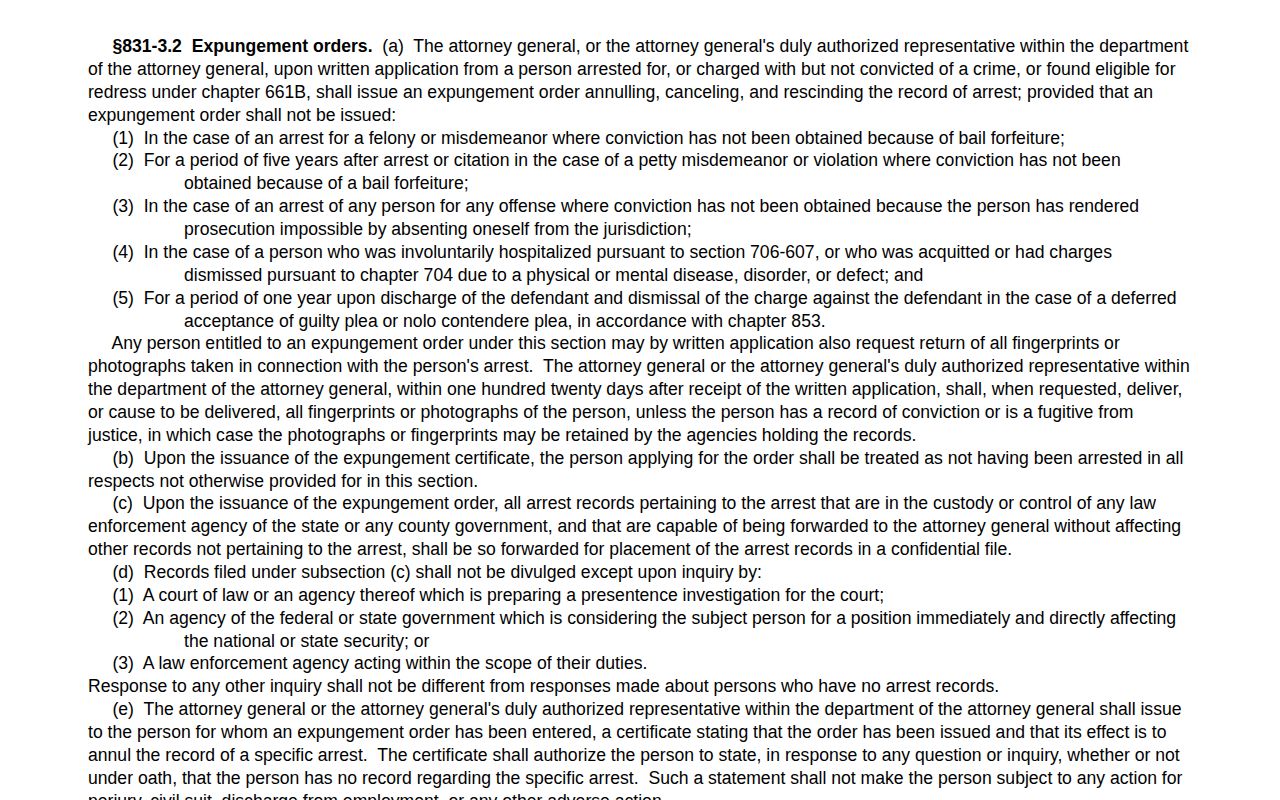
OIP Opinion 94-12 treats county police booking photos as government records under UIPA. In that case, releasing an adult mugshot was not a clearly unwarranted invasion of privacy simply because it showed an arrest. The opinion orders no one to post photos. Nor does it erase the other exceptions. Each agency still examines the specific record in hand. Opinion 03-09 adds the expungement limit. Once an arrest record is expunged, it is no longer public. Its police mugshot becomes protected under §92F-13(4). The mere chance of future expungement is not a reason to withhold a photo that is disclosable now. Chapter 846 does not bar disclosure while an arrest is under a year old, prosecution is pending, or a conviction resulted. Timing and case status drive the answer. An old online copy is not proof of current official access. Two more statutes round out the rules. HRS chapter 846 governs criminal-history information and includes juvenile limits. HRS §571-84 shields covered Family Court and police records, and a child's photo or fingerprint may be used only as law allows. The official text of HRS §831-3.2 spells out the arrest-photo and fingerprint rules.
Why Hawaii Has No Mugshot Ban
No Hawaii statute broadly blocks agencies from releasing adult booking photos. Nothing in state law stops a private publisher. It can show a photo that is already public. Hawaii also lacks a statewide pay-to-remove rule. UIPA exceptions still apply, and so do juvenile confidentiality, expungement, sealed records, and active investigations. Any of these can close off a particular arrest photo.
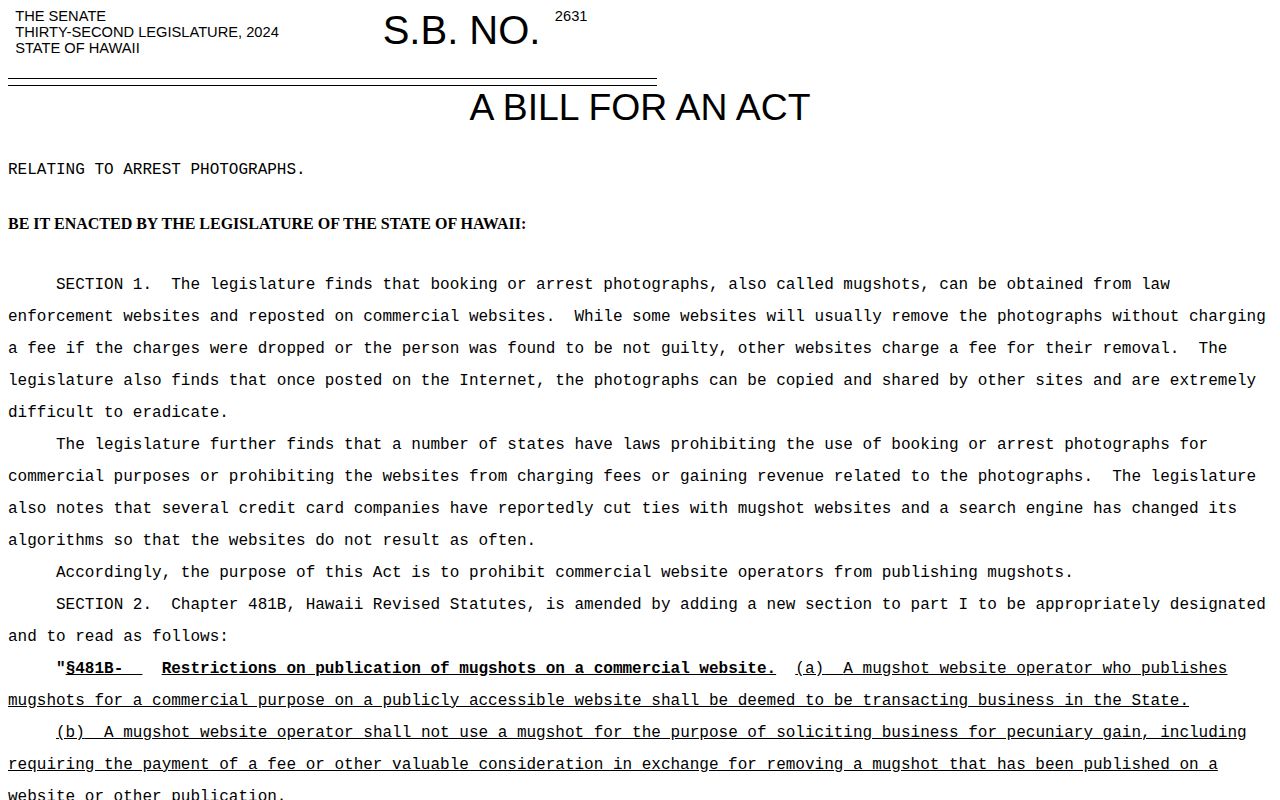
Lawmakers tried to change that in 2024. Senate Bill 2631 would have restricted commercial mugshot publication. It also targeted the payment demands that come with it. Under the draft, a covered publisher counted as doing business in Hawaii. It could not use a booking photo commercially to solicit removal fees. Exceptions were proposed for current or expected proceedings and legal process. The bill died. No Hawaii appellate or reported trial decision has applied an enacted anti-pay-to-remove law. The Legislature's SB2631 archive preserves the full text and its scope.
Note: A proposal can show policy debate, but only enacted law and current court orders govern a person’s record access.
Expunging a Hawaii Arrest Record
HRS §831-3.2 is the key statute. It lets the Attorney General, or an authorized deputy, issue an expungement order. That follows a written application from someone arrested or charged but never convicted. Once granted, the order annuls, cancels, and rescinds the arrest record. Photo and fingerprint cards tied to the arrest fall under it too. The applicant can ask for them back. The statute requires delivery within 120 days. There are two holdouts: a person with a conviction record, or a fugitive from justice. Agencies may keep the materials in those cases.
Eligibility has sharp edges. A felony or misdemeanor arrest that ended in bail forfeiture does not qualify. A petty misdemeanor or violation after bail forfeiture carries a five-year wait. Relief is also barred when someone left and made prosecution impossible. Specified hospitalization or Chapter 704 cases are excluded too. A discharged deferred-acceptance case needs one year. HCJDC lists a four-year wait for one deferred-acceptance charge under HRS §712-1200. Act 152 (2026), following Barker v. Young, clarified eligibility when a crime charge ends in a violation conviction. Remember that a reduced charge is not an expungement order on its own.
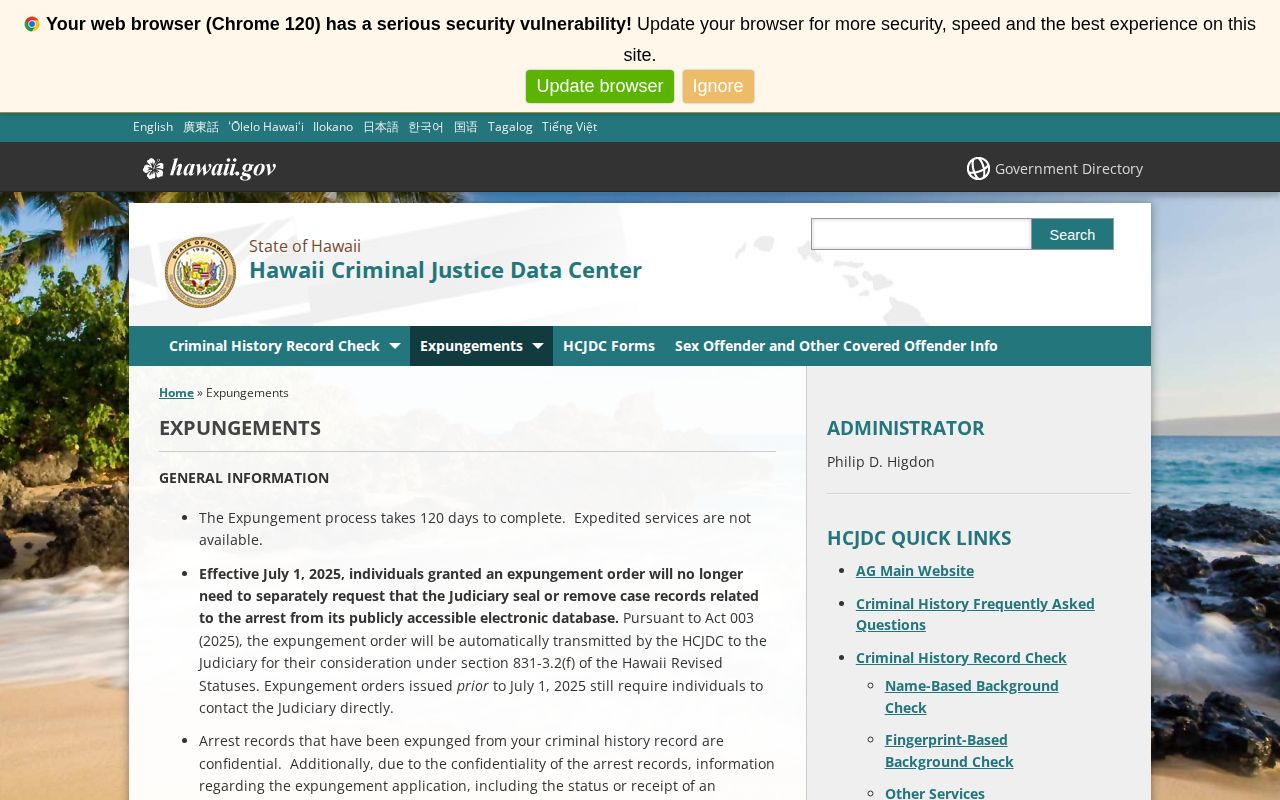
The official HCJDC expungement page posts the current form, fees, and timing. Processing runs 120 days with no expedited option. Fees sit at $35 for a first request. A later one costs $50, and a duplicate certificate runs $20.
| Record step | What changes | What remains distinct |
|---|---|---|
| Arrest expungement | A qualifying order makes the arrest record confidential and removes it from public access under the statute. | The person must qualify and receive an order; a dismissal alone is not the same order. |
| Judiciary transmission | For qualifying orders with a case number issued on or after July 1, 2025, HCJDC sends the order to the Judiciary for consideration of sealing or removal of applicable public case data. | Multiple offenses or defendants can limit the action, and transmission is not a guarantee that every case item disappears. |
| Conviction-information expungement | Relief is available only for specified offenses and conditions and affects the statewide repository. | Records may remain with the arresting agency and the courts. |
| Private copy correction | A publisher may review a free request under its own stated policy. | A publisher’s action does not expunge or amend the government record. |
Orders issued before July 1, 2025 follow a different path. This path covers court records. HCJDC sends people with those older orders straight to the Judiciary. Newer qualifying orders go to the courts for consideration, subject to case exceptions. Conviction-information expungement is narrower. Records can stay with the original police agency or court even after the state repository changes.
How Hawaii Record Systems Differ
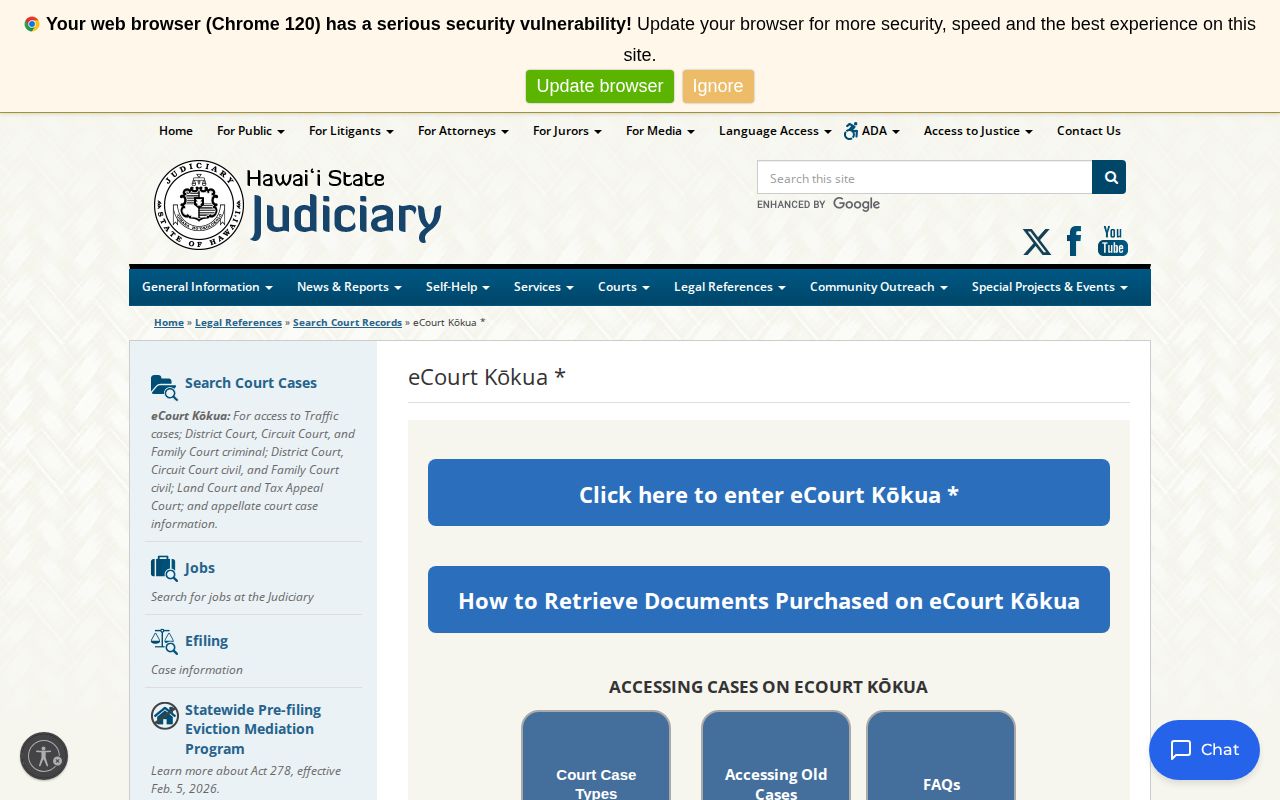
Every system answers one kind of question. County police arrest logs capture selected arrest events and nothing more. The Judiciary runs eCourt Kōkua, which offers public case information plus selected documents, some carrying fees. Sealed and confidential files stay out of that system. HCJDC, through eCrim, leans toward conviction records. DCR and VINELink track custody once the state has taken someone in. So a dead end in one database proves little statewide, since the DLE/Sheriff Division holds its own arrest and incident records apart from all of these.
An arrest entry typically travels through several systems in turn. Arrest comes first, then booking. A court filing follows, then the disposition and possible expungement later. A disposition is simply the court's final result in a case. A booking record and a court case are not interchangeable. Neither one matches a custody alert.
- Booking
- The intake record created after an arrest, before the court decides the case.
- Expungement
- A legal order that annuls and places an eligible arrest record in a confidential file.
- Disposition
- The court’s outcome for a charge or case.
Note: No single portal combines county police bookings, Judiciary cases, state custody, and every independent copy into one official search.
Correcting a Hawaii Arrest Listing
Expungement changes the government record. It does not wipe out every copy across the web. Newspapers, private publishers, image hosts, and search engines keep their own files. So work the problem in layers. First confirm the legal status with HCJDC or the court. Then ask the government custodian about its own record. A private publisher with a copy should be contacted through its documented correction path, sending only the proof it requests. Search engines will refresh a result once the source page changes. They cannot expunge a record that still sits on that page.
Watch for a common gap here. A dismissal, an acquittal, or a not-guilty verdict does not automatically equal expungement, and a vanished search result does not mean the arrest never happened. An old private page, in the same way, proves nothing about whether the government record is still public. Check each one separately.
Some secondary publishers post free correction policies. RecentlyBooked carried a Honolulu listing rather than a full Hawaii roster. Its policy offers no-fee review for certain expunged, sealed, dismissed, incorrect, outdated, wrong-person, juvenile, or duplicate listings, though accurate current public records generally stay up without a listed ground. Mugshots.com takes a similar line. Its record-maintenance policy calls qualifying removals or updates free, asks for proof, and allows up to ten business days. Neither policy can erase an official Hawaii arrest record.
Busted Newspaper, Arrests.org, and Mugshots.zone list no verified Hawaii state or county roster, so no island-specific listing or free correction route applies to them. Local news works differently. Hawaiʻi News Now, the Star-Advertiser, Civil Beat, KHON2, KITV, and Hawaiʻi Public Radio run selected editorial stories, not a complete booking feed, and none promises a free arrest-related opt-out. Use an outlet's correction route for a factual error. A truthful story, though, stays. Official county, court, and HCJDC records remain the authority on status and disposition.
Historical jail and prison material follows a separate path. The Hawaiʻi State Archives corrections finding aid covers collections from 1851 through 1941, including prisoner descriptions and a volume of photographs. An archive catalog does not make a modern booking photo public, and a retention schedule does not keep an arrest PDF online forever. For older material, name the collection and date range, then ask about access and reproduction conditions.