
Hawaii DLE Arrest Authority
DLE is the statewide agency that belongs in the state law-enforcement slot. It is not a state patrol with highway posts or a roster of troopers. The department describes its role as centralizing state law-enforcement functions, and its investigators have statewide authority to investigate and make arrests within their duties. County police remain separate agencies with their own arrest logs, booking records, and custody paths.
The division structure identifies island coverage for Hawaiʻi, Kauaʻi, and Maui, alongside court, airport, capitol, and records operations. Those are statewide functions, not a troop or patrol-district map.
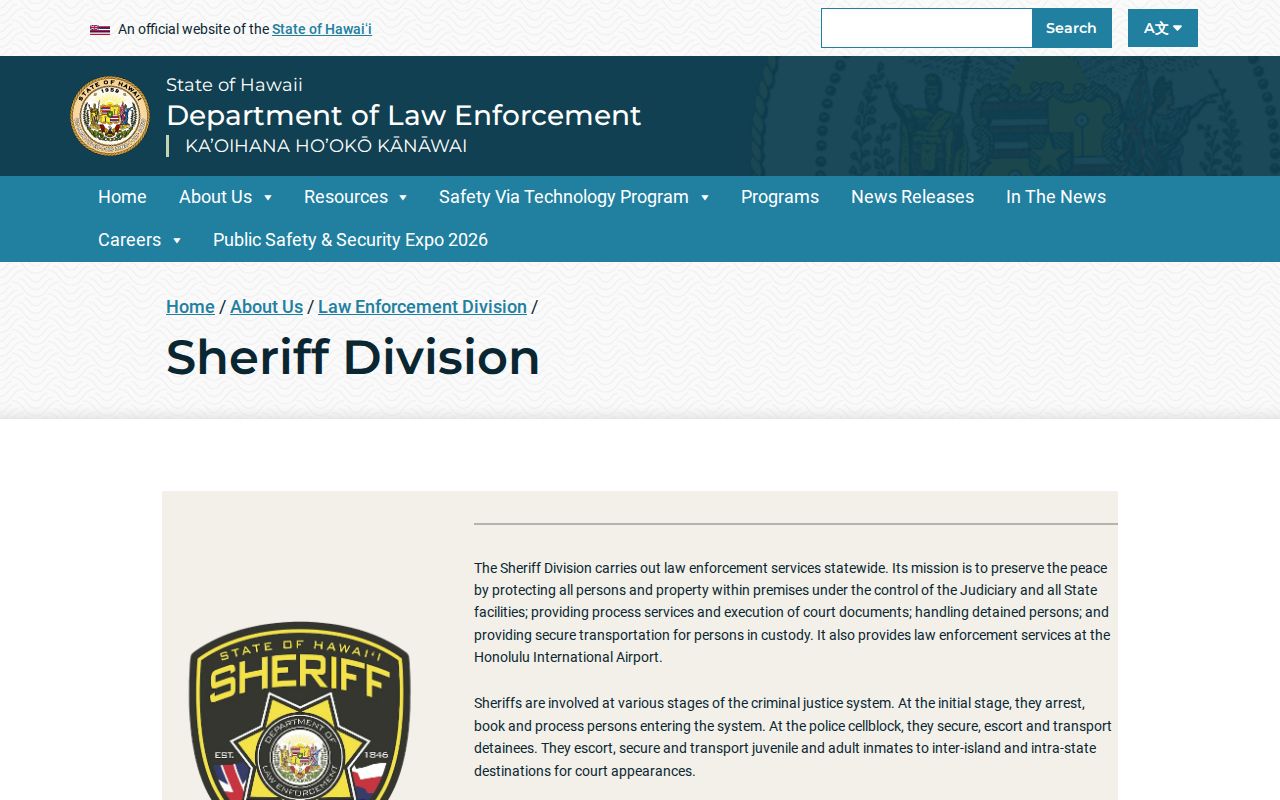
The Sheriff Division supports state facilities and Judiciary premises, serves court documents, and handles detention and prisoner transport. Deputies may arrest, secure, escort, or transport a person. The official division page describes these statewide duties.
What DLE Arrest News Shows
For DLE arrest news, the department's News archive is the best official stop. Individual posts describe selected incidents, name the agency, add event context, and may include a media contact. The archive is event-driven, so posts appear irregularly. Public-safety messages and program notices share space with arrest releases. Not every entry describes an arrest. Nor does every arrest get a post.
| DLE publication | What it offers | Coverage limit |
|---|---|---|
| News and blog archive | Selected arrest and public-safety releases | Irregular, event-driven posts |
| Month archive | Groups posts by publication month | Not a daily activity feed |
| Individual media release | Agency, event date, short account, media contact | Not a full incident file or arrest log |
| Daily activity or dispatch log | No official daily DLE log was verified | Do not infer one from the release archive |
| DUI or checkpoint results | No statewide DLE results archive was verified | County notices are event-specific |
A news release is not a daily activity log. DLE publishes no dispatch log, no daily arrest list, no statewide booking search, and no complete roster. A quiet archive does not mean arrests stopped. The archive carries more than arrests, too. One October 2024 release covered an airport arrest, naming the event, the date, and a media contact. A same-day gun-tip notice shows the mix of public-safety posts. Start with the DLE News archive. Read each post for its date and its named unit. Then confirm any case outcome with the court or the custodian. An old post is not a current custody check.
Note: DLE releases describe selected agency events, so they should be read as public updates rather than a complete count of arrests.
Why Hawaii Has No State Police
Hawaii has no State Police, State Patrol, or Highway Patrol to search. County police departments handle routine enforcement. DLE's statewide reach comes through its divisions and units, sheriff services included, not a patrol grid. There is no troop map. No general state-police activity page exists either. The HDOT Motor Vehicle Safety Office is not a stand-in for a state police arrest feed. Its Motor Carrier Safety work targets commercial-vehicle rules, inspections, weigh stations, citations, and qualifying crashes. That remit builds no highway-patrol roster. Nor does it log every roadway arrest. DLE posts no DUI-checkpoint list or statewide DUI-results archive. County police and traffic-safety partners sometimes publish event-specific campaign results. Those do not form a DLE daily arrest list. The HDOT Motor Vehicle Safety Office page covers commercial-vehicle safety. It covers trucks, not patrol. Anyone hunting "state police arrests" should pair DLE releases with the right county source for local arrest records.
Find a Hawaii DLE Arrest Record
Match the source to the fact you need. The DLE archive can confirm the department publicly described an event. A UIPA request asks for an existing DLE record. County police logs fit when a county agency made the arrest or holds the booking entry. Custody questions go to a separate system. The arrest news archive will not answer them.
- Search the DLE News archive for the event, date, place, and unit. Treat a news post as a selected release, not a full case file.
- If a county police agency made the arrest, use the matching county source or records office. The County Directory routes to the four local systems.
- For a new county arrest entry, check the local feed where one exists. The statewide Arrested Today page compares the published same-day routes and their limits.
- For a DLE report or incident file, send a written UIPA request to DLE with enough detail to identify the record.
- For current custody after a transfer, contact the relevant intake or holding agency. A fresh arrest may not appear in a state custody system while the person remains in a police cellblock.
Keep the arresting agency and the point of custody separate. One agency makes the arrest. Another may hold or process the person later, so a search aimed at the wrong office can miss a record that exists elsewhere.
Where a DLE Arrestee Is Held
DLE runs no single statewide jail roster the public can search. The Sheriff Division secures, escorts, and transports detainees. Yet custody can pass through several doors. The path may be a police cellblock, court processing, a county-police custody route, a DCR intake service center or community correctional center, or federal custody. The route depends on the arresting authority and court action. So no universal jail page follows a DLE arrest. County booking logs help when that county's police handled both the arrest and the booking. They are not a complete list of DLE arrests. DCR is a different layer altogether. It runs the state's correctional facilities and intake services, and its public custody search covers people inside its system, not every person just arrested by police.
DCR’s Corrections Division page explains its state facilities and custody role.
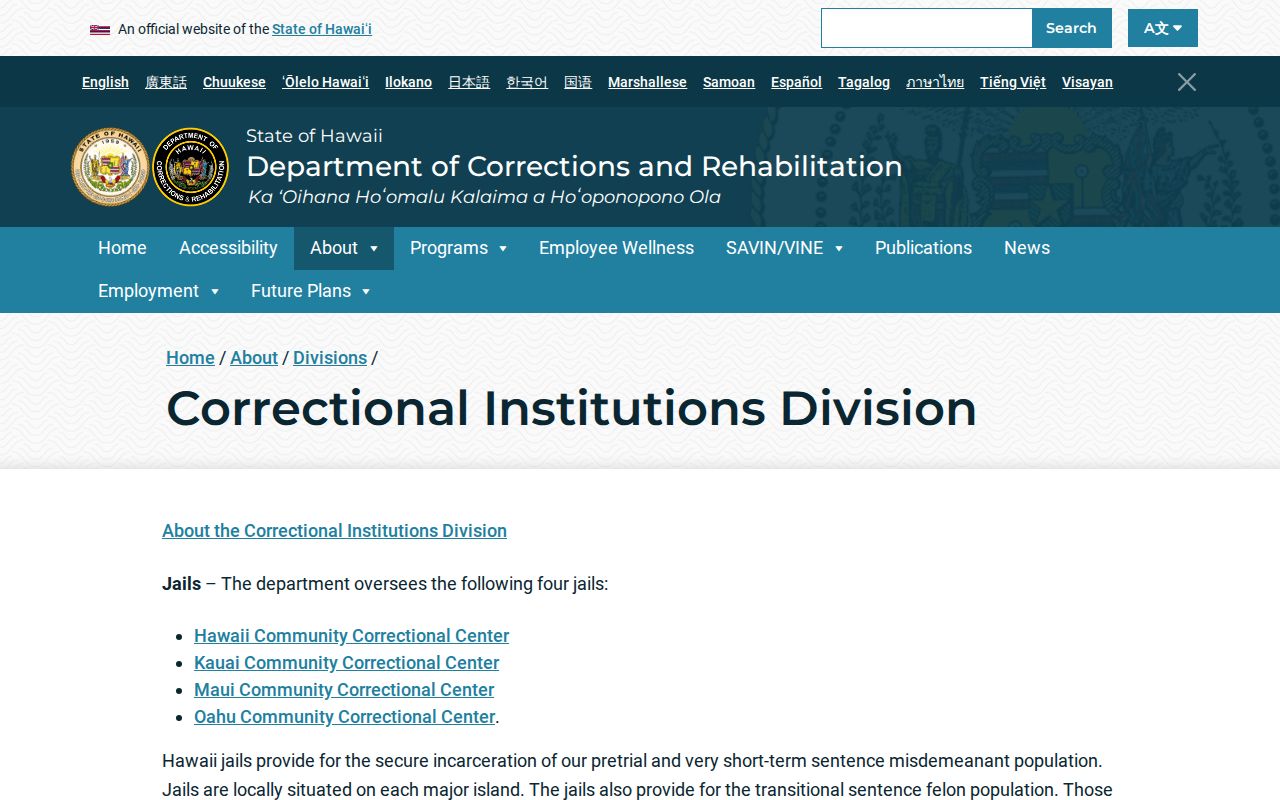
Wondering where a DLE arrestee ends up? DCR lists contacts for its community correctional centers and intake service centers, which handle custody routing. Once someone enters the state system after sentencing, Hawaiʻi SAVIN/VINELink tracks custody and sends change alerts.
County Booking Is Not a DLE Roster
Each county releases booking information its own way. Honolulu Police posts intraday arrest-log PDFs on a fourteen-day public rotation. Hawaiʻi Police puts out rolling forty-eight-hour reports. Kauaʻi Police publishes dated daily PDFs, often the next morning. Maui Police shares selected updates on its official News page but posts no complete online booking roster, and none of these county records form a statewide DLE service.
| County source | Published view | Scope limit |
|---|---|---|
| Honolulu Police | Intraday PDF segments, daily uploads, fourteen-day rotation | Local arrest-log entries, not all state arrests |
| Hawaiʻi Police | Rolling forty-eight-hour PDF reports | Text and table reports, not a photo roster |
| Kauaʻi Police | Dated daily PDFs, often posted the next morning | Rows can list charges and release-disposition codes |
| Maui Police | Selected news posts and request routes | No complete public web booking roster verified |
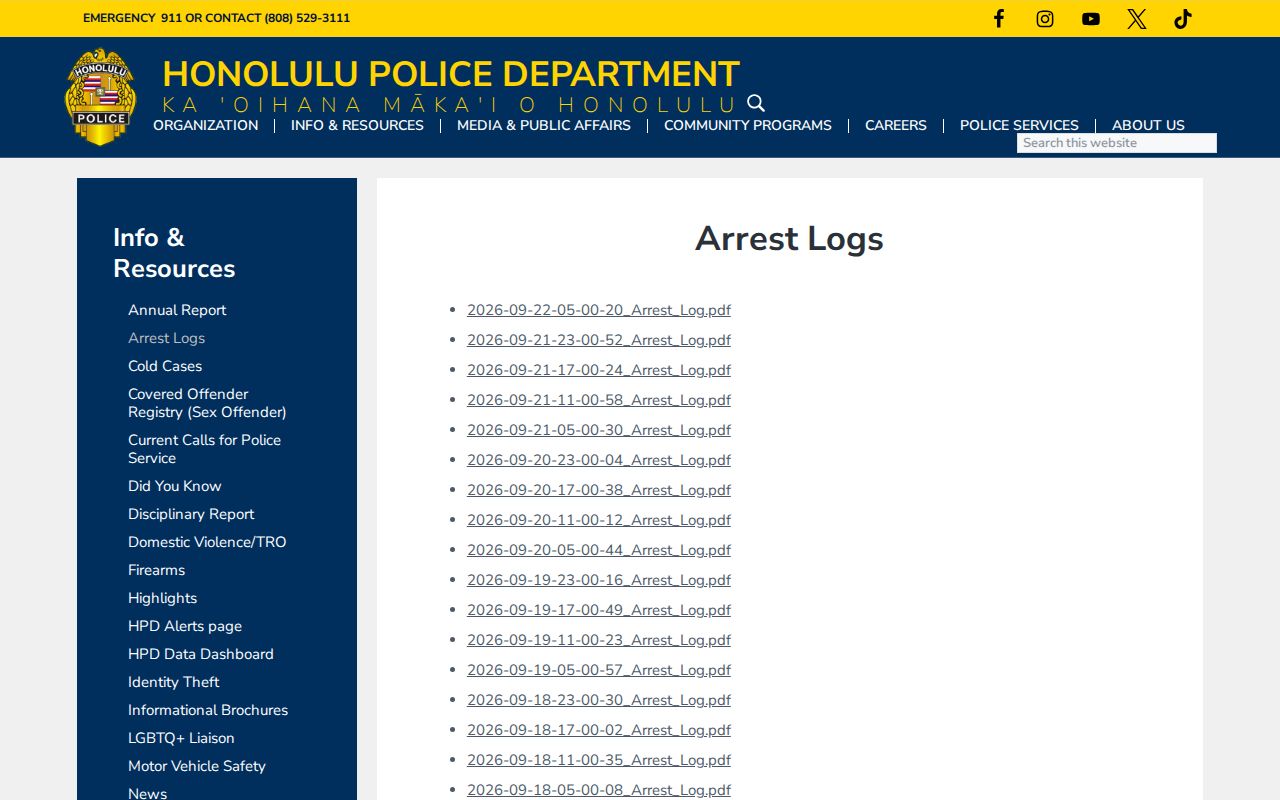
Honolulu’s arrest-log page shows its dated report and archive approach.
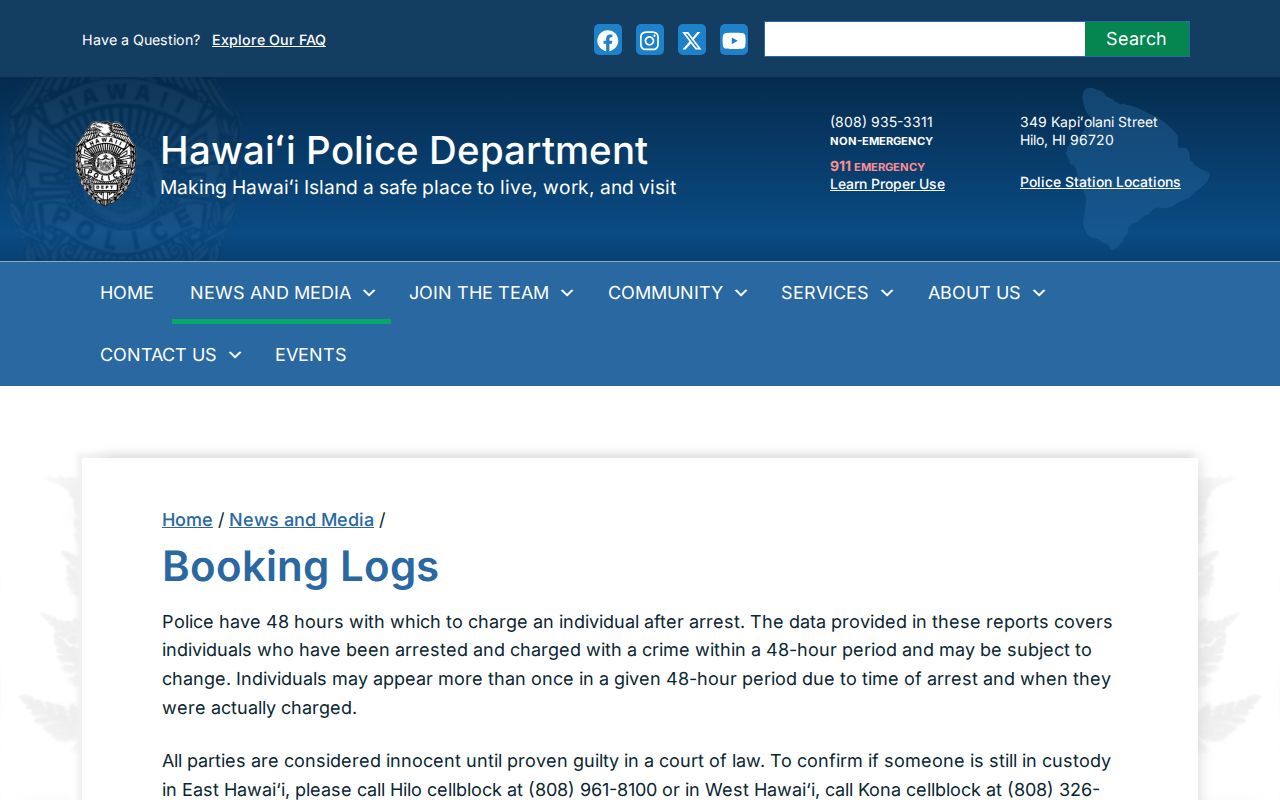
Hawaiʻi Police’s booking-log page uses a different rolling report format.
Kauaʻi Police’s arrest-log page offers a dated daily report.
Check the dates and release codes within a county report’s own scope. A DLE arrest may not show in any county feed, so ask the named custodian when the routing is unclear.
Note: Public PDF depth varies by county, and visible web history does not set the retention period for an underlying record.
Request a DLE Arrest Report
DLE takes record requests through a UIPA page with a fillable form. The request must be in writing. It needs your contact details. Give a clear description of the record. State the format you want. For an arrest, warrant-service, airport, court-security, incident, or transport record, give the date, unit, and location. Add the name if known. Include the record type. Ask whether a booking photo exists and can be released. Do not assume it is posted anywhere.
Send requests to law.uiparequest@hawaii.gov. Or mail DLE at 715 South King Street, Room 505, Honolulu, Hawaiʻi 96813. OIP’s statewide rules allow up to ten business days for a response or a notice. Extra time is allowed in extenuating cases. Search and review fees run $2.50 plus $5 per fifteen minutes. The first $30 is waived. Copies or delivery can cost more. DLE posts no flat arrest-report fee or fixed turnaround.
Use the request form to name the record, delivery method, and contact route:
- Open the official DLE UIPA request page and get the current fillable request form.
- Identify the kind of record: arrest, incident, warrant service, airport, court-security, or transport. Include the date, place, and unit if known.
- Choose inspection or a copy and state the delivery method. Ask the office to contact you before work that may lead to a fee.
- Send the form using the email or postal route stated by DLE, then keep the request and any reply for follow-up.
DLE may release a record. It may redact protected material or withhold part of it under HRS §92F-13. It does not have to create a new statewide arrest list. The department may not keep the record. Ask which agency likely made it or now holds it. A DLE form only reaches that department’s records. It cannot pull a county police booking report. Send that request to the county office that made the arrest. Get the official DLE form and review OIP’s fee and response guide.
After the DLE Arrest Entry
An arrest release is an early record. It is not the case outcome. A later court case may show a charge, a hearing, or a dismissal. It may also show a conviction or another disposition. “Disposition” means the court’s result for a charge. The release may not be updated when the case changes. So read the agency post and the court file as separate records with separate dates. For current custody after a transfer, use the custody agency. An old arrest release will not show it.
Note: DLE news records an agency statement at a point in time; the court record can later show a different charge or case result.