
Hawaii SAVIN After an Arrest
Hawaiʻi SAVIN stands for Statewide Automated Victim Information and Notification. The Department of Corrections and Rehabilitation, or DCR, runs the program. Its public search and registration tools operate through VINELink. DCR calls access free, anonymous, and confidential for victims and any concerned citizen seeking covered custody or parole information. Anyone can look up one person without registering. Signing up is a separate choice for someone who wants a notice when a monitored status changes.
The system answers one narrow question. Is a matching person under DCR custody or parole jurisdiction right now? It is not a statewide arrest database. It will not reproduce every county police booking either. A county officer can arrest someone. The processing can happen at a police cellblock before any court or state correctional step begins. County and state systems do not sync instantly. Until that person reaches a covered DCR system, a VINE search may return no record. The arrest was still real.
The official DCR Hawaiʻi SAVIN page names the state service. It routes visitors to web, phone, mobile-app, and TTY access. VINELink is the interface. SAVIN is the Hawaiʻi program behind it. A result reports custody status only. Treat it as one piece of the larger arrest record.
The service shines after a transfer into a state facility. It also helps once a person's status may change. A victim or family member can stop calling multiple offices for routine updates. Status notices arrive by the contact method chosen at registration. It is not an emergency channel. It is not a safety plan, or a stand-in for an advocate, attorney, or assigned officer. Where immediate action matters, confirm directly with the agency involved.
Check One Hawaii Arrest on VINELink
Need a one-time custody check? The Hawaiʻi person-search route is built for that. The current VINELink Hawaiʻi person search is the live public interface. Treat it as a live service, not a permanent roster copy. Button names and screen order can change. The page is dynamic. Start from the official state SAVIN page when in doubt.
- Choose Hawaiʻi if the state is not already selected. Confirm the state before entering a name, especially if a person has moved or has records in another jurisdiction.
- Enter the person’s name as accurately as possible. If you have an offender, defendant, respondent, or case number that the form accepts, use it to narrow a common-name search.
- Review the matching results one at a time. Compare the available name and identifier details, and do not combine two people because their names look similar.
- Open a likely match and read the status and facility information shown for that record. Note the date and time you checked, since custody can change after the page loads.
- If no result fits, stop short of treating the search as proof that no arrest occurred. Check the arresting county’s own booking source or records contact, then repeat the custody search later if a transfer is expected.
Chasing a fresh booking still held at a county cellblock? County police channels are the better start. The County Directory lists the statewide sites for Hawaiʻi's four county catchments. A same-day report can be delayed. It can also sit in a different date window. An absent entry still needs context from the arresting agency. Search only for the person whose custody information you need. The page is not a profiling tool. A name match can also be wrong. When the status matters, verify it with the agency that holds the person.
Note: A VINELink search can be anonymous; opening a one-time result does not require registering for notifications.
What a VINELink Arrest Result Shows
Fields vary by record and event. The interface itself can change too. DCR's public materials describe custody status, parole status, and notification-relevant events rather than a fixed arrest report. Treat the table as a guide to what a covered result may show, not a promise that every field appears for every person.
| Result information | How to read it |
|---|---|
| Name and identifier | Helps distinguish a matching custody record; confirm more than a name when the interface offers another identifier. |
| Current status | May indicate a covered custody or parole status at the time of the search. Record when you viewed it. |
| Facility or location | May identify a state institution, community correctional center, or intake setting, subject to the displayed record. |
| Release or discharge | Can appear as a status change or notification choice. It does not explain every legal condition of release. |
| Transfer or movement | May reflect a move between covered state locations or custody stages; a fresh transfer can take time to appear. |
| Escape or parole event | DCR materials list these among possible notification-related events, where the record and current interface support them. |
| Booking photo | No public DCR/VINELink photo field was confirmed in the reviewed official materials. |
A custody status line tells you one narrow thing. It is not a police report, a court docket, or a charging document. VINELink does not carry the probable-cause narrative, the evidence, or how a case finally ends. A person can be out of custody while charges move forward in court. The reverse happens too. A court case can outlive a change in booking status. Those records live with the arresting agency or the court itself.
Read the wording carefully before assuming anything. Some entries are alert settings for the future, not events that already occurred. The interface labels each line. It says whether a line means current custody, a past transfer, or a pending notice. When the status matters later, note the time you checked it. That timestamp helps in talks with DCR, a county agency, counsel, or victim services.
Register for Hawaii Custody Alerts
Searching once and signing up for alerts are two different jobs. A search reports what the covered record says right now, while registration looks ahead and asks the service to notify you if an eligible status event occurs later. The DCR brochure lists phone, text, email, in-app, and TTY options. Pick one that works for the record. Keep that route active for as long as the alert matters. The DCR program is free. Its guidance calls it anonymous and confidential too. Phone notifications use a four-digit PIN chosen during setup. Keep the PIN private. Never give it to a caller or anyone outside the official service, and DCR recommends choosing at least two notification methods where available. A backup helps when a number changes, a text is blocked, a filter catches a message, or a device is unavailable.
- Search the person and open the matching covered record. Verify the name and other displayed identifiers before selecting an alert.
- Choose the notification or registration control offered for that record and select the event types available, such as release, transfer, discharge, escape, or another custody change.
- Pick one or more delivery methods shown by the service: phone, text, email, mobile app, or TTY where supported. Enter contact information only in the official VINELink/DCR flow.
- If the setup asks for a phone PIN, create the four-digit code and keep it in a private place. Complete the confirmation steps displayed by the live site or telephone system.
- Check that the registration is active and update the contact route if it changes. If alerts are no longer needed, use the service’s own instructions to adjust or end them.
The official 2025 Hawaiʻi SAVIN brochure lists DCR's notification routes. The service number is 1-877-846-3444. TTY users can call 1-866-847-1298. Confirm the current contact method on DCR's SAVIN page, since its instructions can change. A one-time web search stays anonymous. Alert enrollment is different, because delivery needs the contact details that send the notice. Under DCR's explanation, registration does not reveal who signed up to the person in custody. It also cannot make every event predictable. A matter may call for active safety planning. Keep an advocate, attorney, or assigned officer in the loop. Alerts are an update channel. They do not guarantee a notice beats an event. The service cannot prevent harm.
Note: Keep contact information and any PIN within the official Hawaiʻi SAVIN and VINELink service.
The state's alert service exists to notify you about a covered record, not to publicize a person's information to others. Choose only the updates you need. Protect the device or inbox where a notice lands. A shared phone deserves extra thought. A visible text could create a safety concern, so weigh that before choosing text alerts. The VINELink home and registration page shows the current entry point for signing up.
No person-level custody result appears here. The image shows only the alert-registration route, so follow the on-screen terms and never reuse another person's contact details or PIN.
Which Hawaii Custody Systems Feed SAVIN
Hawaiʻi runs one statewide SAVIN program. It does not run four county-branded VINE systems. The county picture is simpler than that. Four county catchments line up with DCR community correctional centers and intake service centers. That mapping shows state custody destinations tied to the counties, not that every cellblock booking reaches VINELink or that facilities use separate public enrollment controls.
| County or layer | DCR destination named in state materials | What the coverage means |
|---|---|---|
| Hawaiʻi County | Hawaiʻi Community Correctional Center, Hawaiʻi Intake Service Center, and Kona Intake Service Center | State custody can enter SAVIN after intake; a police holding stage comes earlier. |
| Honolulu | Oʻahu Community Correctional Center and Oʻahu Intake Service Center | HPD Central Receiving is a distinct police process before the covered state layer. |
| Kauaʻi County | Kauaʻi Community Correctional Center and Kauaʻi Intake Service Center | A KPD arrest log and police cellblock remain separate from later DCR status. |
| Maui County | Maui Community Correctional Center and Maui Intake Service Center | MPD booking or receiving can precede state intake and visibility. |
| State prison and parole | Halawa, Kulani, Waiawa, Women’s Community Correctional Center, and parole-related DCR/Hawaiʻi Paroling Authority status | Covered state correctional and parole information is a different stage from a county arrest. |
DCR's facility map and frequently called numbers identify the correctional centers and intake locations. The public materials promise no enrollment percentage per county. They also promise no instant appearance of every arrest. The supported picture is a statewide service for records under DCR jurisdiction, with a pre-court police-cellblock gap and event timing that can vary.
Coverage boundary: Hawaiʻi SAVIN tracks covered DCR custody and parole information once it enters the system. County police may hold a newly arrested person first. That stretch falls outside the service. Federal BOP, U.S. Marshals, and ICE custody are separate too, and this state service does not track them.
A Hawaiʻi Island SAVIN governance record describes manual notification and outage contingencies. The lesson is practical. Enrollment never guarantees an instant update or flawless delivery. Unclear about the facility or intake stage? DCR's published contact list can route a call to the right institution, so avoid guessing from a county label alone.

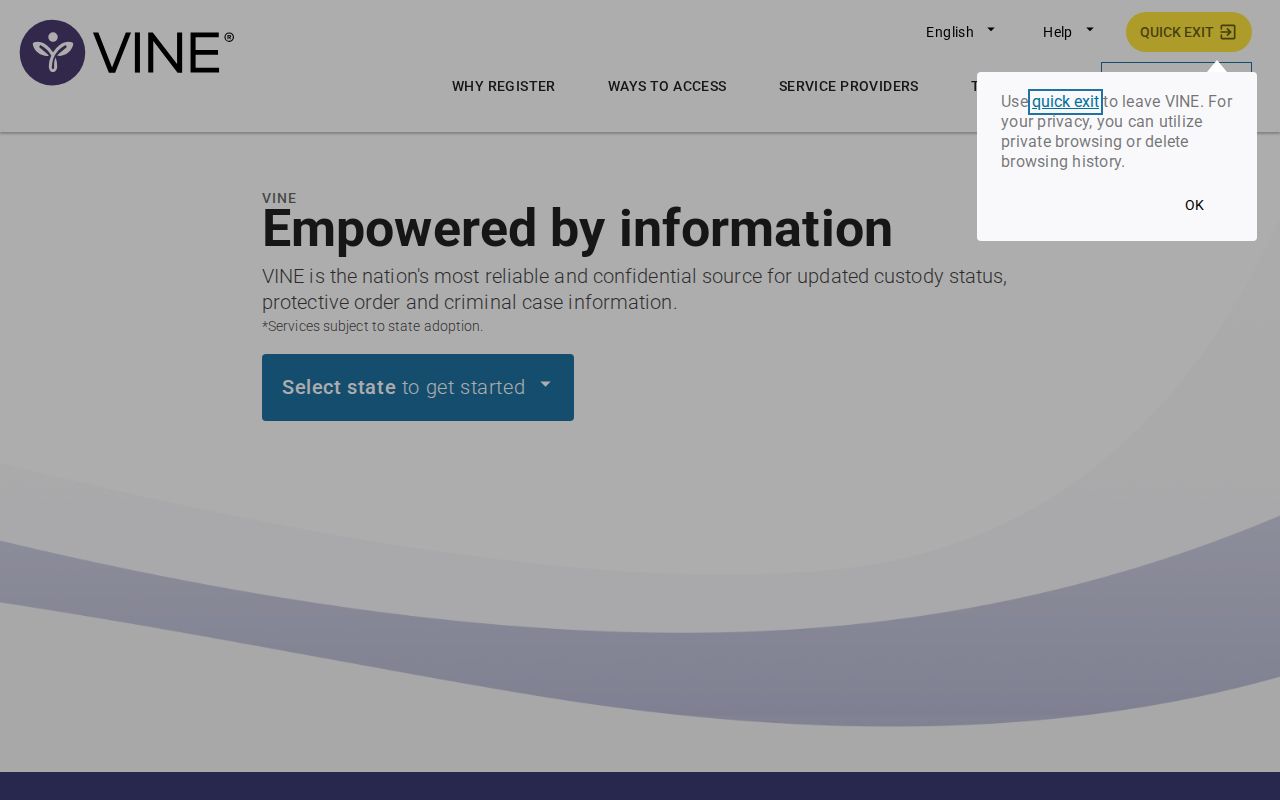
This is the state selection and search entry point. No single person's result shows. The live service may change its design, so check the visible selection before submitting a search.
When a Hawaii VINE Search Has No Result
A blank result means the covered system held no matching record at that moment. That says less than it seems. The search cannot prove that no arrest occurred, that nobody is being held, or that no court case exists. Timing is the most common gap. A person may still sit in a county police cellblock. Waiting for court or transfer can also delay the first appearance in the state custody layer. Spelling can trip the match. So can an incomplete identifier.
Confirm the stage: with a newly reported arrest, use the arresting county's booking or records contact. For a current state facility, contact the relevant DCR institution or check SAVIN again. For a filed court case, use Judiciary case information. When an agency calls a record non-public, ask which office holds it and whether a public portion can be released. Every office holds a piece.
Hawaiʻi police guidance is blunt. VINE does not cover a suspect still held in a police cellblock before the court system, and it does not cover federal prisoners. Between searches, a person can be arrested, booked, released, transferred, or moved into another agency's custody. Custody moves fast. Two views, two clocks. The county's newest public arrest report is an event view, while SAVIN is a later custody and notification view. The Arrested Today page compares the current county reporting windows and explains why a report may not update in step with custody.
Note: Record the search time and the agency contacted so a later status check can be compared with the same custody stage.
An alert is not a safety guarantee. DCR tells users plainly: stay in touch with an advocate, attorney, or law-enforcement officer instead of leaning on SAVIN alone for protection. Notices can arrive late or miss entirely. When timing is critical, direct confirmation beats any automated message.
No result does not mean no arrest. If the record matters right now, call the arresting agency. Ask where the person was booked. Ask which office holds custody today. For a release or transfer question, go to the facility or the assigned professional. An old screenshot or a third-party repost will not settle it. A status page is just a time-stamped view. Custody can change the moment you close it.
Federal Arrests Are Outside VINE
Hawaiʻi SAVIN stops at the state line. It does not track federal custody at all. A person arrested on federal charges can land in several systems. The Bureau of Prisons holds sentenced inmates, pretrial detention may sit with the U.S. Marshals Service, and immigration cases go through ICE. So a SAVIN result, a county arrest report, and a federal locator are not three views of the same thing. Each comes from a different agency at a different stage. When an arrest never shows up in SAVIN, the cause could be one of several things. It might be a booking delay, a release, a non-DCR hold, or a federal path. The empty search alone will not tell you which.
Each federal tool has its own limits. The BOP Inmate Locator offers no public booking-photo gallery and no fresh-arrest feed. The ICE Online Detainee Locator restricts searches by identity and custody age. A brand-new detention may not appear right away. The U.S. Marshals Service District of Hawaiʻi posts only selected fugitive profiles. It is not a full federal booking list. For any federal custody question, go straight to the agency or the federal court. Treating a state VINELink search as a nationwide status check will mislead you.
Custody can also change hands without the records merging. DCR and SAVIN cover state custody well. They cannot confirm an ICE detention, a BOP commitment, or a USMS hold. If a government contact names a different custodian, follow that agency's own route. Keep the date and status context with your search as you go.